Introduction
Security is often treated as a priority only after an incident forces attention. By then, the focus shifts to reacting instead of understanding what allowed the situation to develop in the first place. At Alwinco, we approach security differently. We believe the real value lies in identifying risks before they surface, by looking beyond what appears to be in place and understanding how it actually functions in practice.
An independent security risk assessment provides that perspective. It challenges assumptions, exposes hidden vulnerabilities, and highlights the realities that are often overlooked. This is where meaningful security begins, not in response to failure, but in the decision to assess, understand, and act before something goes wrong.
Most organizations only start asking serious questions about security after something has already gone wrong.

A break-in. An incident. A close call that leaves everyone wondering how it happened.
That’s where we come in.
At Alwinco, the role of the independent security consultant is not to sell a solution but to step into the environment like an investigator. We look at what’s there, how it’s being used, and more importantly, how it could be bypassed, ignored, or exploited. Because criminals don’t follow policies. They look for gaps.
Our objective is to find those gaps before someone else does.
A proper security risk assessment is not a checklist. It’s a process of understanding behavior, patterns, pressure points, and assumptions. We look at how people move, how decisions are made, where attention drops, and where systems rely too heavily on trust or routine. Often, the biggest risks are hiding in plain sight, simply because they’ve become “normal.”
Outstanding performance in this role comes down to a few things.
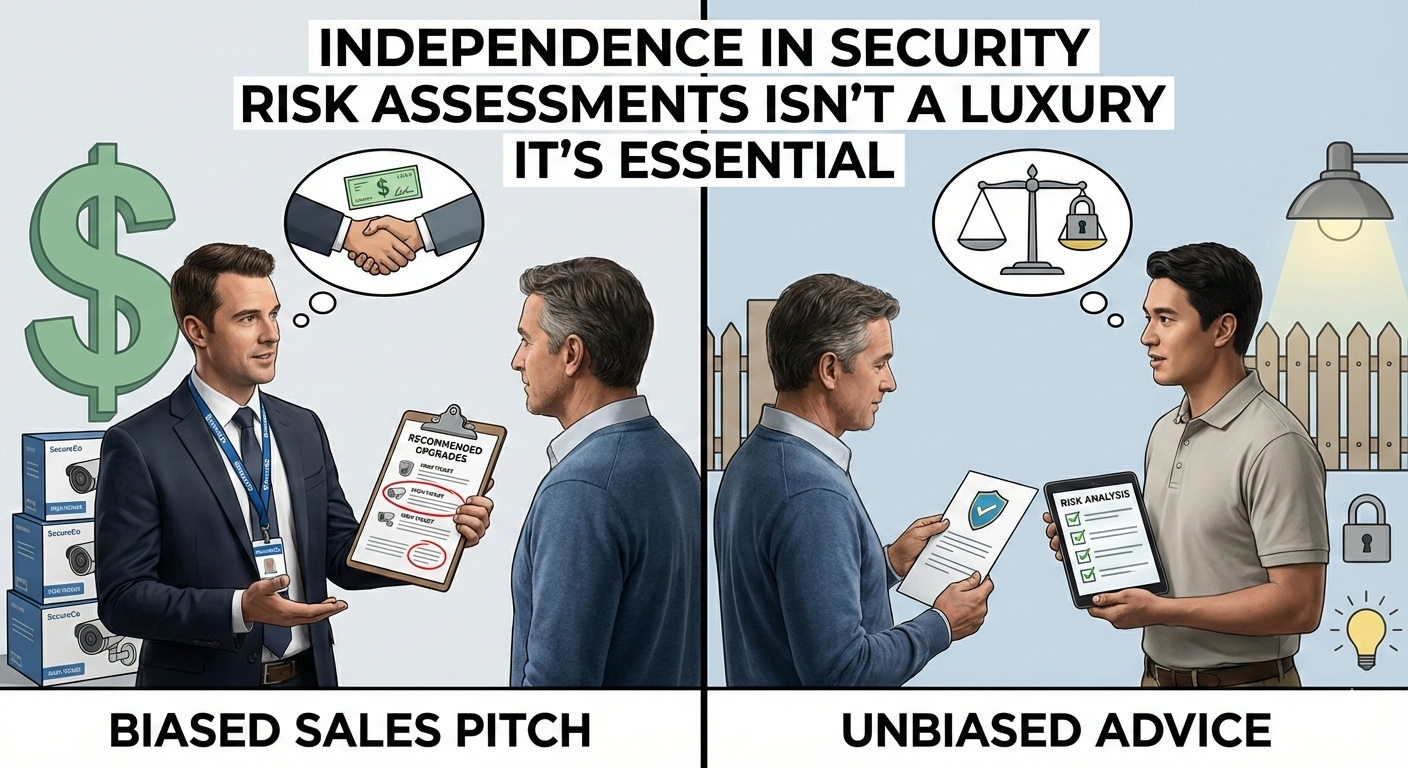
First, independence. Because we don’t sell guarding or technology, there’s no incentive to push a specific solution. That allows us to be honest, even when the findings are uncomfortable.
Second, depth. It’s not enough to point out that a gate exists. We need to understand how it’s used, when it fails, who bypasses it, and why. That level of detail is where real risk lives.
Third, clarity. A report means very little if the client cannot see the risk the way we see it. Our job is to make it real, understandable, and actionable.
Finally, prevention. The best outcome of any assessment is the incident that never happens.
The problem that gets fixed before it becomes a headline. In the end, our role is not to produce documents. It’s to change how organizations see their own security so they can act before they’re forced to react. There’s a moment that happens in many assessments. You’re sitting across from a client, walking them through your findings, and you can see it land. That realization that what they thought was secure… isn’t.
That moment is where real value starts.
At Alwinco, leadership is not about telling clients what they want to hear. It’s about guiding them through what they need to understand. That often means challenging long-held beliefs, like the idea that visible security automatically equals effective security. It doesn’t. And saying that clearly, with evidence to back it up, is part of leading the conversation in the right direction.
Our focus on the client goes beyond delivering a report. Every environment is different, with its own pressures, budgets, and operational realities. A recommendation that looks perfect on paper but cannot be implemented has no value. So, we align our findings with what is practical, achievable, and sustainable.
Where we consistently add value is in what clients don’t see coming.
Many organizations believe their systems are working because nothing has gone wrong yet. But during assessments, we often uncover patterns, behaviors, or overlooked vulnerabilities that could easily be exploited. By bringing those to light early, we shift the client from a reactive position to a proactive one.
Excellence also comes from consistency. Each assessment follows a structured process, ensuring that nothing critical is missed. At the same time, we remain flexible enough to adapt to different environments, whether it’s a residential estate, a school, or a complex commercial site. But the real measure of performance goes beyond the individual client. When a client improves their security based on our findings, it doesn’t just protect their assets. It protects people; it strengthens the surrounding environment. It raises the standard of what “good security” actually looks like.
That ripple effect is where the work really matters.
Because in the end, outstanding performance isn’t about how much we deliver. It’s about what changes because we were there.